

How to Find Accurate Clothing Measurements Online
Table of Contents
- Why Online Clothing Measurements Go Wrong (and How to Fix It)
- How to Measure Your Body for Clothing: Step-by-Step
- Garment vs Body Measurements: What's the Difference?
- How to Read a Clothing Size Chart Guide Without Guessing
- Garment Ease and Fit Preference: The Missing Piece
- Measuring for Non-Standard Body Types and Specific Garments
- Conclusion: Fewer Returns, Better Fits
- Frequently Asked Questions
Last Updated: October 4, 2026
Why Online Clothing Measurements Go Wrong (and How to Fix It)
Ordering clothes online shouldn't feel like a gamble. Yet for many shoppers, it still does. The problem isn't you, and it isn't the clothes.
Here at Peach and Pantry, we hear the same story again and again: "I ordered my usual size and it didn't fit." The reason is simple.
So what actually fixes this? Two things: knowing your real body dimensions, and knowing how each garment is built. Below, we'll walk through both, step by step.
How to Measure Your Body for Clothing: Step-by-Step
Getting your body measurements right takes about ten minutes. Do it once, write the numbers down, and you'll use them for years. You'll need a flexible measuring tape, a mirror, and a friend if you can find one.
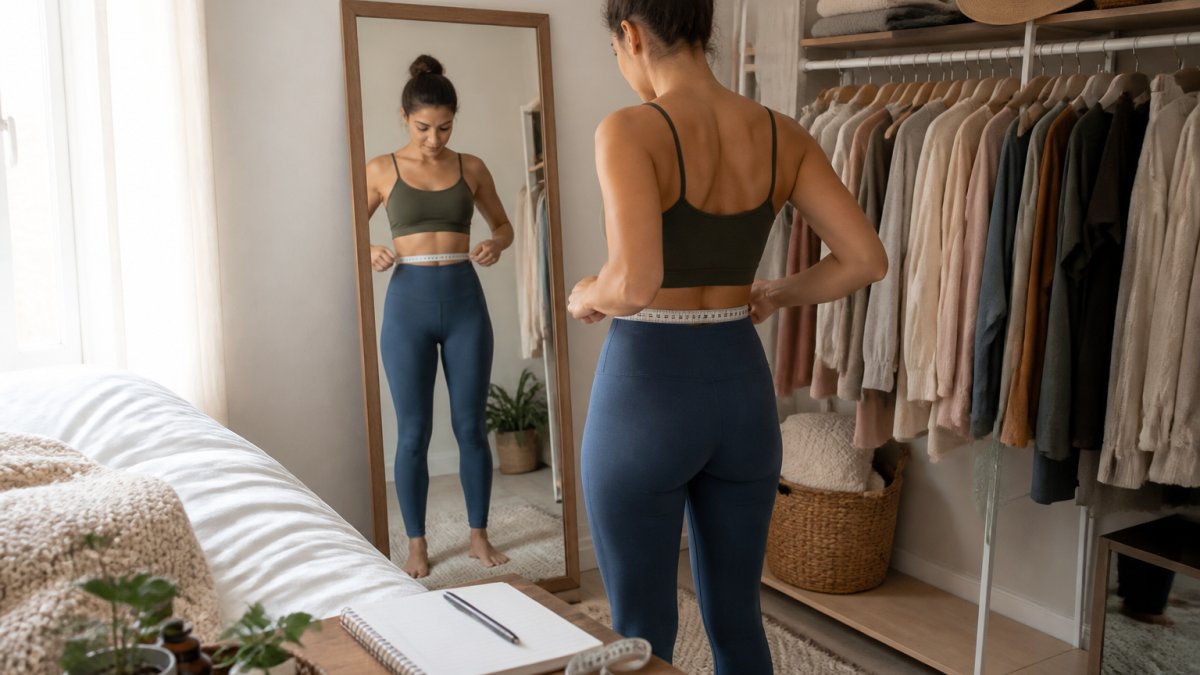
What You Need Before You Start
- A flexible measuring tape, not a stiff ruler
- Fitted clothing, or just your undergarments
- A mirror to check tape placement
- A notebook or phone to record numbers
The Five Measurements That Matter Most
- Bust circumference: Wrap the tape around the fullest part of your chest, keeping it level.
- Waist measurement: Find your natural waist, the narrowest point above your belly button.
- Hip measurement: Measure around the fullest part of your hips and rear.
- Inseam: Measure from your crotch seam down to where you want the hem to fall.
- Shoulder width: Measure across your back from one shoulder point to the other.
Keep the tape snug but not tight. One finger should fit underneath.
Garment vs Body Measurements: What's the Difference?
Body measurements are the numbers you just took. Garment measurements are the actual dimensions of a piece of clothing laid flat. They are not the same thing, and mixing them up causes most fit problems.
A size chart tells you what body the garment is built for. A garment spec tells you what the garment actually measures. When a listing gives you both, use them together. If a store only shows one, ask for the other.
How to Read a Clothing Size Chart Guide Without Guessing
A clothing size chart guide works best when you compare it to your own numbers, not to a size label you've worn for years. Start with your measurements, then find the row where your numbers fall. The catch is that charts are built on different assumptions, so the same three numbers can land you in a different size at every store.
The Three Chart Formats You'll Actually Encounter
Most online listings use one of three formats, and each one requires a different reading method:
- Body measurement charts list the body dimensions a garment is designed to fit. You compare your own measurements directly to the row. This is the most common format and the easiest to use.
- Garment measurement charts list the actual flat-lay dimensions of the finished piece, chest width pit-to-pit, waist across, total length. You compare these to a garment you already own and love, not to your body.
- Hybrid charts mix both, usually labeling body measurements in the size grid and garment measurements in a separate "product measurements" tab. Read the labels carefully; the two sets of numbers are not interchangeable.
How to Match Your Numbers to a Row
Work through the chart in this order:
- Find your primary measurement first. For tops, that's usually bust or chest. For bottoms, it's waist and hip. Locate the row where your primary number sits.
- Check the secondary measurements against that row. If your bust puts you in a Medium but your waist sits in a Large, you're between sizes. Decide based on the fit you want and the fabric's stretch.
- Note the measurement tolerance. Ready-to-wear garments are cut with a manufacturing tolerance, commonly around a quarter inch to half inch on knits and less on wovens. A chart that promises an exact 38-inch chest is describing a target, not a guarantee.
- Check whether the chart is in inches or centimeters. A 90 cm bust is roughly 35.4 inches, not 90 inches. Unit mix-ups are one of the most common online ordering errors.
What to Watch For
- Vanity sizing: Some brands label a larger garment as a smaller size to flatter shoppers. Your "size 8" may vary by inches between stores, and the drift has been documented for decades across women's ready-to-wear.
- Stretch factor: Fabrics with stretch can fit a range of bodies. Rigid fabrics cannot. A chart built for a ponte knit will not translate to a structured wool blazer.
- International size conversion: A US size 10 is not a UK 10 or an EU 38. Always check the conversion table, and remember that men's suiting uses chest circumference in inches while many European brands use metric.
- Petite, tall, and plus lines: These are graded on different blocks, so a Petite Medium and a Regular Medium are not the same garment even when the chart looks similar.
For more on sizing standards and what brands are required to disclose on labels, the FTC's guidance on textile and apparel labeling explains the rules.
Garment Ease and Fit Preference: The Missing Piece
Garment ease is the extra room built into a piece of clothing beyond your body measurements.
Ease comes in two types: wearing ease, which lets you move, and design ease, which creates the silhouette the designer intended. A tailored shirt has little ease. An oversized cardigan has a lot.
This is where fit preference matters. Some people want a relaxed fit. Others want something close to the body. Neither is wrong, but you need to know which you're buying.
Measuring for Non-Standard Body Types and Specific Garments
Standard size charts assume a standard body. Most bodies aren't standard. If you're petite, tall, athletic, or fuller through the bust, hips, or shoulders, measure each area separately and shop by the largest relevant measurement, then adjust for the fit you actually want. This is the section most online guides skip, and it's where accurate measurements pay off the most.
Measuring for Athletic Builds
Athletic frames often carry more circumference in the chest, shoulders, and thighs than a standard chart expects for a given waist. That mismatch is why a runner or lifter can be a Small at the waist and a Large at the shoulders.
- Measure your shoulders and chest first, then size tops to the larger of the two. Tailoring the waist in is far easier than letting out shoulders.
- For bottoms, measure thigh circumference at the fullest point in addition to waist and hip. Many athletic cuts are built with extra thigh room; standard cuts are not.
- Watch sleeve and inseam length. Broader shoulders and longer limbs often push you into a size up, which adds length you may need to hem.
Measuring for Tall and Petite Frames
Height changes where a garment lands on your body, not just how long it is.
- Tall frames: Measure your torso length (shoulder to natural waist) and your rise (crotch seam to waistband) in addition to standard numbers. A top that hits at the hip on a standard frame may sit at the waist on a tall one.
- Petite frames: Measure your shoulder-to-waist and your desired hem lengths. Petite sizing is graded on a shorter block, so a Petite Medium is not just a shortened Regular Medium, the proportions differ.
- Always measure your inseam to the hem you actually want, not to the floor. A 30-inch inseam on a 5'2" frame and a 30-inch inseam on a 5'10" frame describe different hems.
Measuring Through Weight Fluctuation
Weight changes of even a few pounds can shift your waist and hip measurements by an inch or more, especially around the midsection.
- Re-measure every three to six months, or after any noticeable change in how your favorite jeans fit.
- Keep two sets of numbers if your weight fluctuates seasonally: a "lean" set and a "comfortable" set. Shop to whichever matches your current body.
- Prioritize stretch fabrics during transition periods. A knit with 5% elastane will accommodate a range that a rigid cotton twill will not.
Key Measurements by Garment Type
| Garment | Key Measurements | Why It Matters |
|---|---|---|
| Dresses | Bust, waist, hip, torso length | Fit through the torso and where the waist seam lands |
| Trousers | Waist, hip, inseam, rise, thigh | Length, comfort, and whether the waistband sits where you want |
| Shirts | Bust/chest, shoulder width, sleeve length, neck | Arm and shoulder fit; neck size matters for button-ups |
| Coats | Bust/chest, shoulder, sleeve length, back length | Room for layering without swimming in fabric |
| Knit tops | Bust, shoulder, length | Stretch means a wider acceptable range, but length still matters |
A Note on Inclusive Sizing
If you fall between two sizes on a chart, the safer choice is usually the larger size for structured garments and the smaller size for high-stretch knits.
Peach and Pantry carries inclusive sizing from S to Plus Size, so you can shop your real measurements instead of squeezing into a label. Our team is always happy to share garment specs when you need them.
Conclusion: Fewer Returns, Better Fits
The frustration of a bad fit is real, but it's fixable. Take ten minutes to record your body dimensions. Learn how garment ease and size charts work. Then shop with confidence.
At Peach and Pantry, we make that easier with inclusive sizing and free shipping storewide (excluding houseplants and accessories). Get started with Peach and Pantry and find pieces that fit the first time.
Frequently Asked Questions
What are the most important body measurements for online shopping?
Focus on five: bust circumference, natural waist, hip measurement, inseam, and shoulder width. These cover most fit decisions for tops, dresses, and bottoms. For pants, add rise measurement. For sleeves, add sleeve length. Write these numbers down once and keep them in your phone. When a size chart lists garment specifications, compare your body dimensions to the chart's numbers, not to the letter size you wear at another store.
Should I measure my body or measure a piece of clothing I already own?
Both methods work, but they answer different questions. Body measurements tell you your actual dimensions. Measuring a garment you already love tells you how much fabric you prefer around your body, which is garment ease. For online shopping, start with body measurements to find your base size, then check the garment specifications. If you have a favorite shirt, measure it seam-to-seam and compare those clothing dimensions to the size chart.
Why do clothing sizes vary so much between brands?
Vanity sizing is the main reason. Over decades, brands have gradually labeled larger garments with smaller numbers to make shoppers feel better. A size 10 at one retailer may match a size 14 at another. Standardized sizing does not exist across the apparel industry. This is why body dimensions and garment specifications matter more than the number on the tag. Always check the specific brand's size chart before ordering.
How do I use a size chart correctly when buying clothes online?
Find the size chart on the product page. Locate your bust, waist, and hip measurements on the chart. If you fall between two sizes, size up for woven fabrics with no stretch and size down for knits with high stretch factor. Check whether the chart lists body dimensions or garment specifications. Body dimensions assume the garment will fit close to your skin. Garment specifications include the ease built into the design.
Have a question about sizing before you order? Reach out to our team, and we'll help you find your perfect fit.